

Sturgeon Point: A Photograph and a Feeling
Updated: Jul 27
Finding sanctuary on Lake Huron
An old friend of mine shared a photo with me recently. It immediately caught my attention.
There are places that become memorable because something extraordinary happened there.
There are places whose importance sneaks up on us and comes from something much more simple. The places were built for purpose, fulfilled it faithfully, and with little fan fare. Over time, they become part of our landscape almost without anyone noticing.
Sturgeon Point Lighthouse is one of those places.

Standing on the shores of Lake Huron just south of Alpena, Michigan, the lighthouse has safely guided sailors since 1869. It was built to warn ships of the shallow reef stretching into the lake and to guide ships toward the protection of a naturally sheltered harbor, known by sailors as Sanctuary Bay. For generations, its purpose wasn’t to become a destination or a landmark. It simply helped people find safety.
That quiet sense of purpose is the type of thing I find compelling in places like Sturgeon Point Lighthouse.
Finding Sturgeon Point — Light at the End of the Tunnel
Sturgeon Point Lighthouse is not the most famous Greatl Lakes lighthouse. The places that inspire often aren’t the busiest or the most photographed places. They’re places that seem comfortable with the passage of time.
Ironically, my introduction to the lighthouse wasn’t through a visit. It was through the photograph my friend Jeff Barrett captured during his family’s Memorial Day trip to Northern Michigan in 2020. After months of COVID restrictions, returning north carried, for Jeff, a significance that went beyond a weekend away.
When he talked about the photograph, Jeff described the lighthouse as feeling like “light at the end of the COVID tunnel.” It wasn’t simply a building anymore. It had become a symbol of hope, continuity, and returning to something familiar.

The black-and-white treatment stripped away distractions and emphasized something deeper than architecture. It suggested endurance. Jeff shared that he likes black-and-white photography because it lets you see the “grandness” of a building or structure.
It’s a medium Jeff feels comfortable with and returns to often if it’s a lighthouse or a shanty house in Leland’s Fishtown.
From Photo to Paper
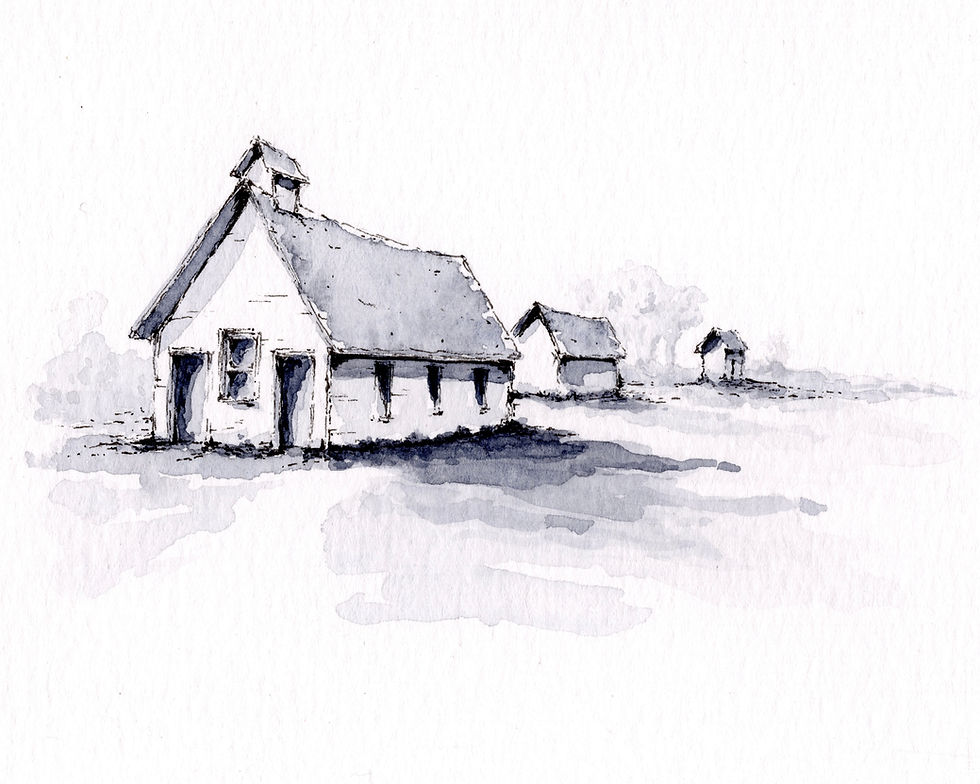
As I began thinking about painting this, I realized I wasn’t interested in reproducing Jeff’s photograph in perfect detail. A camera had already told that story beautifully. Instead, I wanted to explore the feeling and atmosphere the image created when I first saw it. A feeling of solitude and the idea of a lighthouse standing guard while enduring years of beatings from long Lake Huron winters.

Finding that feeling meant simplifying the composition and allowing the open space around the lighthouse to carry as much visual weight as the structure itself. The balance between the manmade structure and the landscape. The sense that this lighthouse had quietly witnessed generations come and go without ever asking to be noticed.
It’s an approach at the center of Stoney Bend. Using art to record a places while focusing less on the exact detail of how places appear, and more in capturing why they stay with us.
Memory has a way of editing the world. We rarely remember every architectural detail of a place we love, but we remember its atmosphere almost immediately. We remember how it felt to stand there, or in this case, how a photograph made us feel.
Sanctuary - Sturgeon Point
When Jeff later saw the finished painting, he told me he appreciated that it wasn’t simply a

watercolor version of his photograph. He shared that he felt “honored to see his photo being used as inspiration to create a piece of art.”
His reaction meant a great deal to me because it confirmed something I’ve come to realize. Art doesn’t need to duplicate what already exists. It can serve a way to document how a place makes you feel.
Capturing that feeling was my goal with the painting. Capturing it’s story, and how it guided sailors to the safety of Sanctuary Bay is what lead to the title.
Sanctuary — Sturgeon Point.
What Makes a Place Memorable
Jeff routinely ventures up north, and always has a camera in hand. His photographs reflect the same quiet beauty that draws so many back to Northern Michigan.

Whether it’s the preserved farmsteads of Port Oneida, a quiet downtown storefront, or a lighthouse overlooking Lake Huron, the Northern Michigan places that leave the deepest impression are often the ones that have served a purpose for a very long time.
They don’t compete for attention. They become beloved through consistency, patience, and endurance.
Perhaps that’s why Sturgeon Point feels relevant today.
We don’t navigate the Great Lakes the way sailors once did, and few of us depend on lighthouse beacons to find safe harbor. Yet the idea behind the lighthouse still resonates. We crave places that remind us where we are when life begins moving a little too quickly. Places that quietly endure while so much else changes around them.
For Jeff, Sturgeon Point was one of those places. And his photo gave me an opportunity to add my view to the place. A place that continues to matter not because it demand our attention, but because it faithfully offers something we still need.
Maybe that’s what sanctuary has always meant.
Scott
Enjoyed this Story? There are more waiting at The Bend. You can also subscribe to Studio Notes for occasional notes from the studio which are more conversation versus newsletter.



Comments